
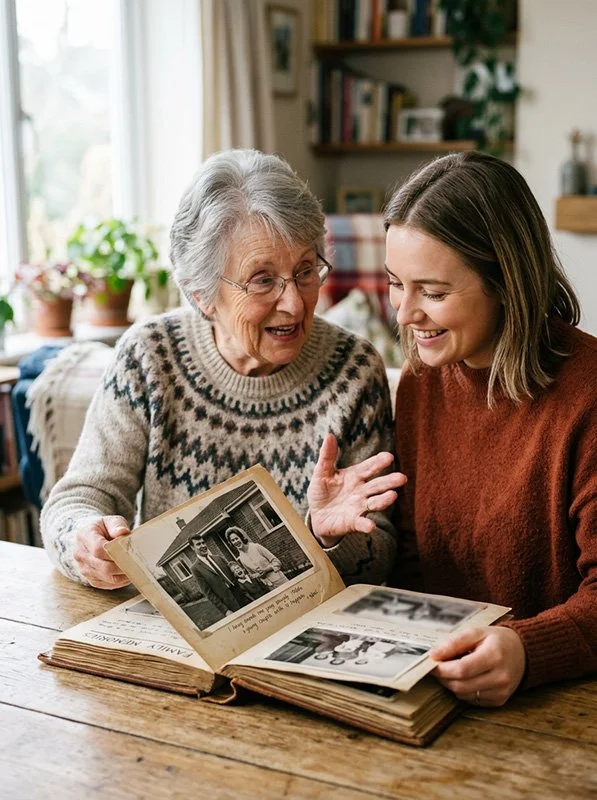
Every family carries stories that live in only one person's memory. The way your grandmother describes the ship that brought her here. The reason your dad walked away from his first job. The small, funny detail about how your parents met that never made it into the official version. These stories feel permanent while the person telling them is still around. Then one day they aren't, and the story goes quiet with them.
Most families don't lose their history in a dramatic way. They lose it slowly, through good intentions and busy weeks. We mean to sit down and ask. We assume there will be time. And the details that seemed too ordinary to write down turn out to be the ones we'd give anything to hear again.
Recording a family story changes that arithmetic. It takes something fragile and makes it something a child, a grandchild, or a great-grandchild can return to whenever they need it.
Facts fade. Voices stay.
A photograph tells you what someone looked like. A birth certificate tells you when they arrived. Neither tells you how your grandfather sounded when he laughed, the phrases he reached for when he was proud of you, or the pauses he took when a memory still hurt. A recording holds all of that. Years later, a grandchild who never met him can press play and hear a real person rather than read a summary of one.
That difference matters more than we tend to expect. Voice carries personality in a way the written word can't fully capture. It carries warmth, humour, hesitation, and love. For a young person trying to understand where they come from, hearing it directly is closer to knowing the person than any family tree could ever be.
Knowing your story builds a stronger sense of self
There's a well-known piece of research on this from psychologists Marshall Duke and Robyn Fivush, who developed what they called the "Do You Know?" scale. They asked children a set of questions about their family history: where their grandparents grew up, how their parents met, what hard times the family had come through. The children who knew more of these stories tended to show greater resilience, higher self-esteem, and a stronger sense that they could handle what life threw at them.
The theory behind it is simple and quite moving. Children who understand that their family has weathered hardship and kept going come to see themselves as part of something larger and more durable than their own worries. They inherit not just names and dates, but a sense of belonging and continuity. Your family has survived difficult things before. You are part of that line. That knowledge steadies people, especially when their own lives get hard.
A recorded story is one of the most direct ways to pass that steadiness down.
It carries values, not just events
When someone tells the story of their life, they're rarely just listing what happened. They're telling you what mattered to them. Why they made the choices they made. What they were afraid of and what they were proud of. What they'd do differently and what they'd do again without hesitation.
These are the things families most want to hold onto, and they're almost never written anywhere. A recording captures the quiet philosophy a person lived by, in their own words, without anyone having to translate it or guess at it later. A grandchild facing a hard decision can hear how their grandmother thought about courage, or forgiveness, or hard work, and take real guidance from it.
It gives grief something to hold
There's a particular comfort in having a loved one's voice after they're gone. Grief can make the past feel slippery, as though the person is receding a little more each year. A recording keeps them close. Families play these stories at weddings, at anniversaries, on quiet evenings when someone is missed. Children who were too young to remember a grandparent grow up able to meet them anyway.
This isn't about clinging to the past. It's about letting the people we love keep contributing to the family long after they've gone, in celebration as much as in sorrow.
The best time to record is now
The instinct to wait is natural. We assume the story will keep. But memory is the one thing that doesn't wait, and the ordinary telling of a life is only possible while the person is here to tell it.
Recording a family story is one of the kindest things you can do for people who don't exist yet. It's a gift handed forward to a generation you may never meet, saying: this is who we were, and now you know.
At We Are Bound, that's the whole reason we exist. We help families capture these stories properly, in the teller's own voice, so they're there for everyone who comes after.